
ITR Filing Last Date for FY 2025-26 (AY 2026-27)
The official last date to file your Income Tax Return (ITR) for FY 2025-26 (AY 2026-27) is July 31, 2026 for salaried individuals, and August 31, 2026 for small businesses and professionals not requiring a tax audit. Missing your respective deadline triggers a mandatory switch to the New Tax Regime, a late fee of up to ₹5,000, and interest penalties on unpaid tax.
5/22/20263 min read

Filing your Income Tax Return (ITR) on time is one of the most critical financial responsibilities for any taxpayer in India. Missing the statutory deadlines can result in heavy penalties, interest accumulation, the loss of tax saving advantages, and unnecessary legal notices.
As the current tax season is officially underway, this comprehensive compliance guide outlines the updated deadlines, key revisions under the Finance Act 2026 and actionable insights to keep your personal and business finances fully compliant.
Key ITR Filing Due Dates for 2026
The Income Tax Department establishes different deadlines based on your specific income sources, taxpayer category, and whether your business accounts require a mandatory audit.
Please note that for the current Assessment Year (AY) 2026-27 (pertaining to income earned between April 1, 2025, and March 31, 2026), the filing deadlines are split as follows:
1. Non-Audit Cases (Individuals & Professionals)
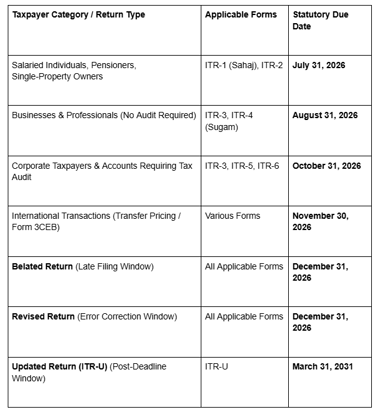
Salaried Individuals & Pensioners (ITR-1 & ITR-2): The standard deadline remains July 31, 2026.
Non-Audit Businesses & Professionals (ITR-3 & ITR-4): Under the newest compliance updates, the deadline for non-audit taxpayers filing under presumptive taxation or regular business schemes has been distinctively structured for August 31, 2026.
2. Audit and Corporate Cases
Tax Audit Required: For corporate entities, firms, and individuals whose accounts must be audited under Section 44AB, the filing deadline is October 31, 2026.
Transfer Pricing Cases: Companies involved in international or specified domestic transactions requiring an accountant’s report in Form No. 3CEB must file by November 30, 2026.
3. Missed the Deadline? Late Filing Timelines
Belated & Revised Returns: If you missed your original deadline or need to correct an error in your submitted form, both Belated and Revised returns must be completed on or before December 31, 2026.
Fast-Check Compliance Table (AY 2026-27)

Consequences of Late Filing: Why Filing Early Matters
Waiting until the last minute or missing the ITR filing last date carries strict statutory consequences under the Income Tax Act, 1961:
Late Filing Fees (Section 234F): If your total income exceeds ₹5 lakh, a mandatory late fee of ₹5,000 will be levied when filing a belated return. If your total income is within ₹5 lakh, the fee is reduced to ₹1,000.
Interest on Unpaid Taxes (Section 234A): You will be liable to pay additional interest at 1% per month (or part of a month) on any unpaid tax liabilities, calculated from the original due date until the day you actually file.
No Old Tax Regime Option: Late filers lose the flexibility to choose the Old Tax Regime. If you file a belated return, you will be mandatorily evaluated under the Default New Tax Regime.
No Carry Forward of Losses: Late filing blocks your right to carry forward current-year business losses, capital losses, or speculative losses to offset against future profits. Only house property losses are exempted from this rule.
Important Changes to Keep in Mind for This Filing Cycle
Expanded Scope of ITR-1: Individual taxpayers can now report income from up to two house properties in ITR-1 (Sahaj), a massive shift from previous cycles where owning a second property required moving to a complex ITR-2 form.
Mandatory Disclosures in Presumptive Tax: Taxpayers filing under presumptive schemes (ITR-4) must mandatorily report all operational bank balances held during the fiscal year under Schedule BP.
Strict Verification Check: The e-filing portal has completely integrated real-time data with your Annual Information Statement (AIS) and Form 26AS. Ensure that your declared income matches your investment proofs to avoid automated tax notices.
Frequently Asked Questions (FAQs)
Q1. Can I file my ITR if my income is below the taxable limit?
Yes. Filing a "Nil ITR" is highly beneficial as it serves as official income proof for loan approvals and visa processing. Furthermore, if your income falls below the primary exemption limit, no penalty under Section 234F is levied even if you file after the due date.
Q2. What is the difference between a Belated Return and an Updated Return (ITR-U)?
A Belated Return is filed after your regular deadline but before December 31, 2026. An Updated Return (ITR-U) is a special window enabling you to correct tax data or file skipped returns up to 48 months from the end of the relevant assessment year (i.e., until March 31, 2031), subject to an additional tax penalty ranging from 25% to 50%.
Q3. Will my income tax refund be delayed if I file late?
Yes. Processing priorities are given to returns filed within the original statutory timeline. Delaying your filing can substantially postpone the processing of your data and eventual refund credits.
Conclusion & Expert Tax Support
Staying compliant with changing Indian tax regulations doesn't have to be overwhelming. Securing your timelines prevents unnecessary legal penalties and sets up your financial record cleanly for the upcoming assessment cycle.
Don't wait for the last minute server rush. Get your documentation verified and file your tax returns seamlessly with the professionals at Filing4u.
Get in Touch with Us Today:
Call us +91 7980984206
Copyright 2026 Filing4u. All Rights Reserved. Powered by Digital Nari
Get In Touch
Tel : +91 79809 84206
Email : info@filing4u.com
Locations : Kolkata | Bangalore | New Delhi | Mumbai
H.O: 10 Camac St, Elgin, Industry House, 11th Floor, Kolkata, West Bengal 700017