
GST vs. Income Tax: A Beginner’s Guide to Staying Compliant in India
GST is an indirect tax on what you spend or sell, collected throughout the year on transactions. Income Tax is a direct tax on what you earn, paid annually on income and net profits. Business owners often handle both, while salaried professionals typically pay only Income Tax.
Sneha Das
6/18/20263 min read

Step 1: Understand GST (Goods and Services Tax)
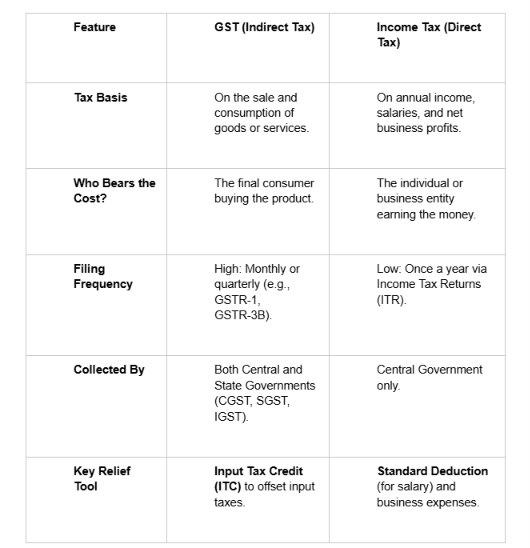
GST is an indirect, consumption-based tax levied on the supply of goods and services. The final consumer who buys the product or service ultimately bears the cost.
How it works: If you run a business, you collect GST from your customers during a sale on behalf of the government. Before passing it to the tax department, you can subtract the GST you paid on your own business purchases a feature called Input Tax Credit (ITC).
Who needs it? Under current guidelines, registration is mandatory for most businesses selling goods if annual turnover exceeds ₹40 lakh. For service providers, the mandatory threshold is ₹20 lakh.
The Goal: It unifies multiple older indirect taxes into a single "One Nation, One Tax" system, removing the burden of tax-on-tax (cascading tax).
Step 2: Understand Income Tax & The Standard Deduction
Income Tax is a direct tax levied on your annual net earnings. It applies to salaried employees, freelancers, professionals, and business entities based entirely on financial success over a financial year.
How it works: Your tax liability is calculated on your total income after subtracting allowable deductions or business expenses. Under the default New Tax Regime, taxable income up to ₹12 lakh is entirely tax-free due to the Section 87A rebate.
The Standard Deduction Benefit: For salaried individuals and pensioners, the government provides an automatic Standard Deduction of ₹75,000 under the new regime. This flat amount is deducted right off your gross salary before tax calculations begin, without requiring any bills or proofs.
The Math: This pushes the effective tax-free income limit to ₹12.75 lakh for salaried individuals (₹12.75 lakh minus the ₹75,000 standard deduction equals ₹12 lakh, which qualifies for a full tax rebate).
Step 3: Compare Key Differences at a Glance
Step 4: Keep Both Systems Aligned
For business owners, GST and Income Tax data are systematically interconnected. The annual turnover you report across your monthly GST filings must match the gross receipts or turnover you declare on your annual ITR. Significant discrepancies between the two datasets can trigger automated red flags and lead to tax audits. Keeping synchronized records in your accounting software is the best way to ensure both sides remain consistent.
Frequently Asked Questions (FAQs)
Q1. Is paying Income Tax mandatory if my business already pays GST?
A. Yes. GST is an indirect tax collected from your clients based on sales volume. Income Tax is a direct tax paid on your net business or personal profits. They are governed by separate laws, so you must comply with both if you clear their respective thresholds.
Q2. Can a business owner claim the ₹75,000 Standard Deduction?
A. No. The Standard Deduction is reserved strictly for salaried employees and pensioners. Business owners instead claim actual "business expenses" (like office rent, utility bills, raw materials, and employee salaries) to reduce their taxable business profit.
Q3. What happens if I cross the threshold but fail to register for GST?
A. Operating above the statutory limits (such as ₹40 lakh for goods or ₹20 lakh for services) without a valid GSTIN is a legal violation. It can attract heavy financial penalties, interest on unpaid taxes, and a restriction on moving goods across state lines.
Q4. How many returns do I need to file?
A. Under GST, standard taxpayers file two returns monthly (GSTR-1 and GSTR-3B) or quarterly under the QRMP scheme. For Income Tax, individuals and businesses only file a single Income Tax Return (ITR) once a year, selecting the specific form that matches their income profile.
Conclusion
Navigating Indian compliance doesn't have to be overwhelming. Think of GST as the tool tracking your transactional activity throughout the year, while Income Tax assesses your bottom-line financial success at the end of it. Effectively using Input Tax Credits for your business and claiming the ₹75,000 Standard Deduction on your salary can save you significant money and stress.
Contact Filing4u Today
At Filing4u, we specialize in ensuring your filings are accurate, fully optimized, and compliant with the latest rules. Let us handle the paperwork while you focus on growth.
Call us +91 7980984206
Copyright 2026 Filing4u. All Rights Reserved. Powered by Digital Nari
Get In Touch
Tel : +91 79809 84206
Email : info@filing4u.com
Locations : Kolkata | Bangalore | New Delhi | Mumbai
H.O: 10 Camac St, Elgin, Industry House, 11th Floor, Kolkata, West Bengal 700017