
GST Registration for Freelancers in India – Complete Guide
Wondering if you need GST as an Indian freelancer? You must register once your income crosses ₹20 Lakh (₹10 Lakh in NE states). If you serve foreign clients, registration is mandatory from ₹0 turnover to claim Zero Rated Supply via an LUT and pay 0% tax on export income. Even below the threshold, voluntary registration lets you claim Input Tax Credit (ITC) on GST paid for laptops, software, internet and co working spaces.
Sneha Das
6/18/20265 min read
When Does a Freelancer Need GST Registration?
In the eyes of Indian tax law, a freelancer is classified as a "service provider." Under the updated rules, registration on the official portal becomes mandatory under specific scenarios.
1. The Threshold Limits
For most service providers, GST registration is mandatory if your total aggregate turnover exceeds ₹20 lakh in a financial year. However, if you operate from specific Special Category States (Manipur, Mizoram, Nagaland, and Tripura), this baseline threshold drops to ₹10 lakh.
Note: While the threshold for exclusive suppliers of goods is ₹40 lakh, freelancers providing services must strictly abide by the ₹20 lakh/₹10 lakh service limit.
2. Export of Services (Working with International Clients)
If you provide services to clients outside India (via platforms like Upwork, Fiverr, or direct cross-border contracts), you are executing an "inter-state supply." To legally offer services to overseas clients without paying a flat 18% Integrated GST (IGST), you must register for GST and file a Letter of Undertaking (LUT). This grants you "Zero-Rated Supply" status, allowing you to pay 0% tax on foreign earnings while letting you claim refunds on your business expenses.
3. E-commerce Platforms and Aggregators
If you acquire clients or receive payouts through modern freelance digital platforms, these aggregators are required by law to deduct Tax Collected at Source (TCS). To smoothly process these payouts, claim the deduction back, and comply with platform financial guidelines, having a valid GSTIN is essential.
The Financial Risk of Delayed Registration
Delaying your registration once you cross the threshold can cost you heavily. If you cross the legal limit and continue to operate unregistered, you face a minimum penalty of ₹10,000 or 10% of the tax due (whichever is higher). Furthermore, premium corporate clients will outright refuse to work with you because they cannot claim tax credits on your invoices.
Why Voluntary Registration is a Strategic Power Move
Even if your annual revenue is well below ₹20 lakh, registering for GST voluntarily can give your freelance business a massive competitive edge.
Claiming Input Tax Credit (ITC): As an independent professional, your operational costs add up. Laptops, hardware, software subscriptions (Adobe Creative Cloud, Zoom, Slack, Microsoft 365), high-speed internet bills, and co-working space rentals all carry a steep 18% GST rate. If you are registered, you can offset the GST you pay on these business expenses against the tax you owe, essentially pocketing an 18% discount on your core tools.
Boosting B2B Credibility: Large companies and corporate clients prefer working with GST-registered vendors. It allows them to claim their own input credits on your fees. Having a 15-digit GSTIN instantly elevates you from an "informal gig worker" to a trusted corporate business partner.
Seamless Global Invoicing: Voluntary registration allows you to apply for an LUT right away. This ensures you can scale globally and receive international wire transfers legally without losing a chunk of your invoice to domestic tax pools.
GST Rates and Invoicing Rules for Freelancers
Most professional freelance services: including software development, copywriting, graphic design, consulting, and digital marketing — fall squarely under the 18% GST tax slab.
When you issue a tax invoice to a domestic client, it must be structured properly to be legally compliant. Every GST invoice you generate must include your legal business name, registered address, and 15-digit GSTIN; the legal name, billing address, and GSTIN of your client (if registered); a unique, consecutive alphanumeric invoice number unique to that financial year; the date of issue; the SAC (Services Accounting Code) matching your exact service (e.g., 998314 for Graphic Design or 998313 for Information Technology services); and a clear breakdown of the tax applied, CGST + SGST for clients inside your home state, or IGST for clients located in a different Indian state.
Step-by-Step: Freelancer GST Registration Online
The entire enrollment process is conducted digitally through the government's official portal (gst.gov.in). To ensure a seamless application process, keep the following documentation ready.
Required Document Checklist: Identity proof (PAN Card, mandatory, and Aadhaar Card); a clear, passport-sized photograph; proof of business address (for a rented home/office, a rent agreement along with a recent electricity bill or property tax receipt in the landlord's name, plus a signed No Objection Certificate from the owner; for an owned home, a recent electricity bill, municipal khata copy, or property tax receipt in your name); bank account verification via a cancelled cheque or recent bank statement showing your name and address clearly; and an active mobile number linked to Aadhaar for OTP and biometric verification.
Once your application is submitted without errors, the tax authorities typically verify and approve your GSTIN within 3 to 7 working days.
Managing Compliance: Filing Your Returns Simplified
Filing your tax returns doesn't have to be an administrative nightmare. The government provides specialized schemes designed to reduce the paperwork burden on small business owners and independent professionals.
1. The QRMP Scheme (Highly Recommended)
Most freelancers prefer the Quarterly Return Monthly Payment (QRMP) scheme. This layout allows you to file your detailed outward invoices (GSTR-1) and your tax summary return (GSTR-3B) just once a quarter, saving you from heavy monthly account tracking while preserving your full right to claim Input Tax Credit (ITC).
2. The Composition Scheme (For Limited Use)
If you prefer simplicity over tax savings, the Composition Scheme allows service providers with an annual turnover under ₹50 lakh to pay a flat 6% tax on turnover (using quarterly form CMP-08 and annual GSTR-4). However, this comes with major trade offs: you cannot claim any ITC, you cannot collect GST from your clients, and you are strictly barred from working with international or out-of-state clients.
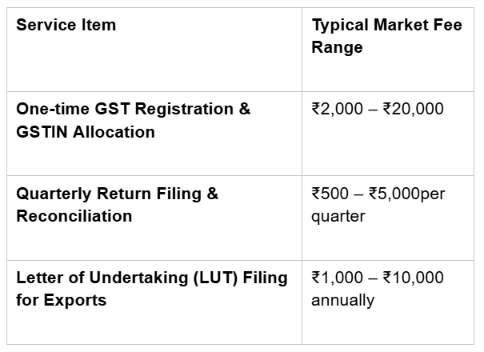
GST Registration Cost 2026
While the government portal charges ₹0 in official processing fees for registration, professional assistance is highly recommended to avoid structural filing errors, mismatches in address proof, or wrong SAC selections that trigger tax department notices.

Frequently Asked Questions (FAQs)
Q1. Is GST registration compulsory for all freelancers in India?
A. No. GST registration is only compulsory if your aggregate annual turnover crosses ₹20 lakh (₹10 lakh for specific northeastern states), if you sell via certain e-commerce aggregators, or if you provide export services to international clients and want to claim 0% tax benefits using an LUT.
Q2. Can a freelancer claim GST back on a laptop, iPad, or software?
A. Yes! Through the Input Tax Credit (ITC) mechanism, a registered freelancer can deduct the 18% GST paid on business tools—like MacBooks, smartphones, office furniture, Adobe Creative Suite, or co-working space fees directly from the tax collected from domestic clients.
Q3. Can I do GST registration for my freelance business using a home address?
A. Yes, you can legally use your residential address as your principal place of business. You will simply need to upload a utility bill (like an electricity bill) in your name, or a rent agreement alongside an NOC from the property owner if the property belongs to a parent or landlord.
Q4. What is the penalty for not registering for GST if I cross the threshold?
A. Failing to register after crossing the ₹20 lakh threshold attracts a heavy penalty under Section 122 of the CGST Act, which is a minimum of ₹10,000 or an amount equal to the tax evaded, whichever is higher.
Conclusion
Obtaining your GST registration is more than just checking off a legal box; it is a vital badge of business maturity that opens doors to enterprise-level clients, eliminates global payment friction, and saves you hard-earned money via tax credits. By building your freelancing setup on a clear, legally compliant foundation, you ensure your business is fully prepared to scale.
Need Professional Help For GST Registration?
Don't let tax jargon hold your freelance business back. Let Filing4u Consultancy take the anxiety and complexity out of your compliance journey. Our expert team handles your documentation, registration, and routine filings flawlessly while you focus on what you do best.
Call us +91 7980984206

Copyright 2026 Filing4u. All Rights Reserved. Powered by Digital Nari
Get In Touch
Tel : +91 79809 84206
Email : info@filing4u.com
Locations : Kolkata | Bangalore | New Delhi | Mumbai
H.O: 10 Camac St, Elgin, Industry House, 11th Floor, Kolkata, West Bengal 700017