Delhi High Court Cracks Down on Meesho Over Jockey Trademark Violation
The Delhi High Court has issued a strict ex-parte interim injunction against e-commerce giant Meesho, ordering it to take down counterfeit listings violating the registered trademark of global apparel brand JOCKEY within 36 hours. Intermediaries cannot escape accountability when hosting copycat vendors. Meanwhile, for professionals reviewing their financial compliance, remember that the Standard Deduction remains a critical tax relief tool, currently standing at a flat ₹75,000 under the New Tax Regime.
Sneha Das
6/26/20263 min read

Step 1: Identify the Violation (JOCKEY vs. Deceptively Similar Brands)
The legal dispute, Jockey International Inc. v. M/s D.R. Kuppraj Tex India & Ors., escalated when the plaintiff discovered rogue online vendors capitalizing on Jockey's stellar market reputation. The court highlighted that multiple listings were using names intentionally designed to confuse everyday shoppers.
The specific infringing brand names banned by the High Court include:
JOYKE
JOYEBEE
JOYESS
JOJOKE / JOYSKY
Justice Jyoti Singh observed that because these copycat products targeted the exact same consumer segment and utilized identical trade routes, public confusion was practically guaranteed.
Step 2: Implement the Court’s Directives (The 36-Hour Takedown and KYC Mandate)
To protect intellectual property in India's digital marketplaces, the High Court imposed two major mandatory requirements:
The 36-Hour Takedown Window: Meesho must completely block or suspend all infringing product URLs within 36 hours of being formally notified. This underscores the strict guidelines modern marketplaces must follow under India's IT Rules to maintain their "safe harbor" legal immunity.
Unmasking the Rogue Sellers: To eliminate anonymous counterfeit operations, Meesho was directed to turn over comprehensive Know Your Customer (KYC) details of the offending vendors within four weeks. This includes physical registration addresses, active mobile numbers, UPI payment transaction histories, and digital IP logs.
Step 3: Align Business Compliance with Tax Rules (The Standard Deduction Link)
While establishing a business and defending corporate intellectual property is vital, corporate health is tied directly to personal financial compliance. As a baseline tax-saving strategy for salaried founders, employees, and corporate executives in India, the statutory Standard Deduction acts as an effortless tax relief mechanism.
Default New Tax Regime: The Standard Deduction allows an automatic deduction of ₹75,000 directly from your gross salary before calculating tax liability: no bills or premium proofs required.
Old Tax Regime: The Standard Deduction is capped at ₹50,000.
The Compliance Strategy: Under the active tax regime structure, a salaried individual earning a gross salary of up to ₹12.75 lakh effectively owes zero income tax after combining this flat ₹75,000 deduction with the standard Section 87A rebate (which waives tax on net incomes up to ₹12 lakh).
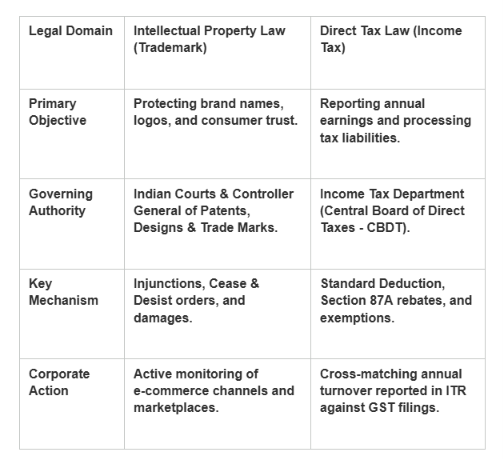
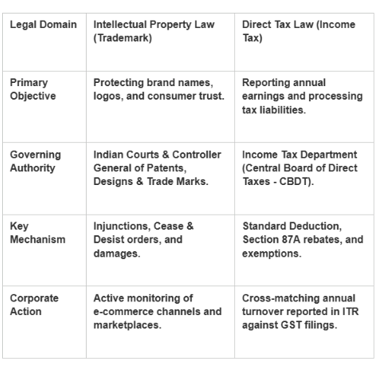
Step 4: Compare Trademark Enforcement vs. Tax Compliance
Conclusion
The Delhi High Court's decisive action against Meesho sends an unmistakable warning across India's retail ecosystem: e-commerce platforms cannot act as a passive shield for counterfeiters. For trademark owners, it reinforces the immense legal weight of proactive brand registration. For internet intermediaries, it highlights the necessity of strict seller verification.
Whether you are seeking to secure an official trademark to defend your brand’s identity or managing your corporate tax filings to leverage the highest allowable deductions, Filing4u provides expert legal clarity every step of the way. Let our dedicated compliance team navigate the heavy legal and tax paperwork while you focus on scaling your enterprise.
Frequently Asked Questions (FAQs)
Q1. What constitutes trademark infringement under Indian law?
A. Trademark infringement happens when an unauthorized entity utilizes an identical or "deceptively similar" mark for identical goods or services. If the unauthorized mark creates a high likelihood of public confusion or deceptively rides on the reputation of an established brand, it violates the Trade Marks Act.
Q2. Can an online marketplace be sued for counterfeit items sold by third-party sellers?
A. Yes. Under the Information Technology (IT) Rules, e-commerce platforms enjoy "safe harbor" status only if they act purely as neutral intermediaries. If a platform fails to act swiftly: such as removing a verified copycat listing within 36 hours of a formal court order, it loses this protection and can be held directly liable for intellectual property violations.
Q3. What seller metrics are platforms forced to turn over during corporate litigation?
A. As seen in the Meesho Jockey verdict, courts regularly compel platforms to provide extensive background datasets on counterfeiters. This includes complete KYC forms, official billing addresses, phone numbers, localized IP logs tracking their digital footprint, and connected bank or UPI payment accounts.
Q4. Can a business owner or independent freelancer utilize the ₹75,000 Standard Deduction?
A. No. The flat ₹75,000 Standard Deduction is legally restricted to salaried employees and individuals receiving a pension. Business entities and freelancers instead minimize their taxable net income by deducting legitimate business expenses like raw material procurement, platform commissions, rent, and utility costs.
Need expert help? Connect with Filing4u for Expert Legal & Tax Support
Call us +91 7980984206
Copyright 2026 Filing4u. All Rights Reserved. Powered by Digital Nari
Get In Touch
Tel : +91 79809 84206
Email : info@filing4u.com
Locations : Kolkata | Bangalore | New Delhi | Mumbai
H.O: 10 Camac St, Elgin, Industry House, 11th Floor, Kolkata, West Bengal 700017